


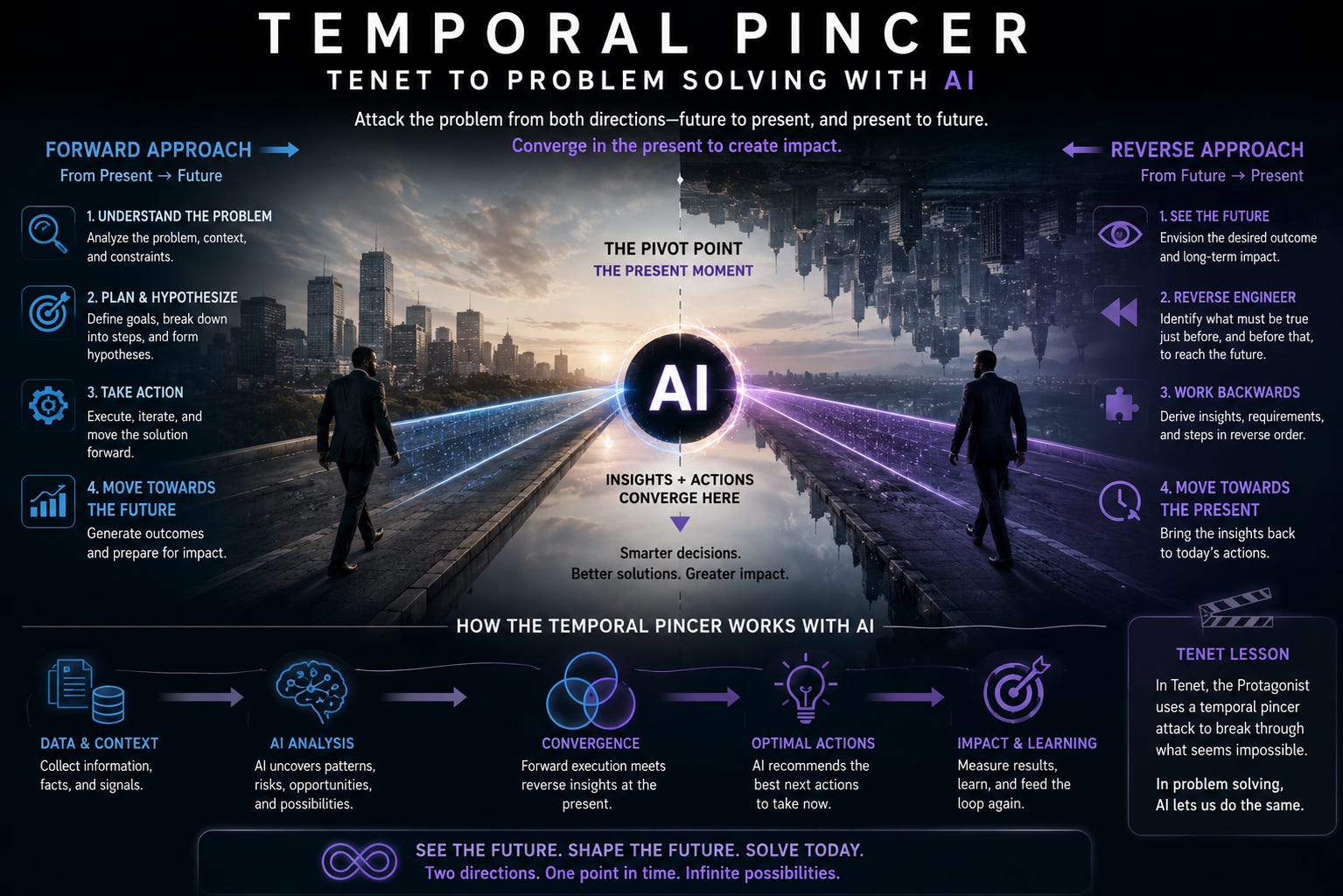
Here’s a trick from Tenet: one team moves forward through time, another moves backwards, and they squeeze the same moment from both ends at once. The team going backwards already knows how it turns out, so it can radio tips to the team still fumbling forward.
You don’t need a time machine to steal this. You just need to write two documents instead of one.
Most of us plan the normal way: start from today, list what needs to happen, work forward. It’s honest, it’s grounded, and it’s also completely blind to the thing that’s actually going to bite you in month four — because from where you’re standing today, you can’t see it yet.
So do something slightly odd. Separately, without looking at your forward plan, write the story of how it all worked out — but write it from after the deadline, in the past tense, like a memory. What did “done” actually look like? What had to be true right before the finish line? And, the fun part: what nearly killed it?
Then put the two side by side. Where they agree, great, leave it alone. Where they disagree — that’s the whole game. That gap is usually the exact thing that would have quietly sunk you, found in week one instead of month five.
Why this works better than it has any right to
A pre-mortem alone just asks “imagine it failed, why?” A forward plan alone just asks “what’s next?” Neither one talks back. The pincer makes them argue with each other until they agree, and arguments are where honesty leaks out.
Run this a few times, and you’ll notice the future rarely says “you didn’t try hard enough.” It says things like “you were missing one specific relationship,” or “you were counting on a door that was actually closed,” or “you needed to decide this in advance, calmly, instead of deciding it live, under pressure, with an offer on the table.” Cheap fixes in week one. Expensive discoveries in month five.
What you actually walk away with
One folder, but really just one file worth reading: a plan that opens with what to do this week, the single biggest insight the exercise turned up, then the fuller action list, the things to watch for, and your kill criteria — the tripwires for when to stop or change direction, decided now, while you’re calm, because you will absolutely not decide them this clearly once you’re three months in and emotionally invested. Everything else — the forward pass, the backward pass, the comparison between them — is just how the sausage got made. You don’t have to relive it.
Three places this earns its keep
Corporate — the launch everyone’s watching. Your team has committed to shipping the new flagship feature in time for the big industry keynote in September. Marketing’s already teased it. The forward plan looks like every launch plan ever: a clean sequence of engineering milestones counting down to launch day.
The backward pass — written as if it’s October and the launch went well — casually mentions something the sprint board never would have: that the whole thing nearly slipped when a “minor” integration with a partner API turned out to need three weeks of back-and-forth nobody had scheduled, and that the closest call was a legal sign-off that sat in someone’s inbox for eleven days because nobody owned chasing it. Nobody plans for “the sign-off that sits in an inbox.” But everybody’s shipped a launch that got wrecked by exactly that.
How to run it: write the frame as something a stranger could check (”feature live, demoed on the keynote stage”), and do the exercise before the roadmap is locked — not after the first Slack message that says “quick heads up, we might be a week behind.”
Social sector — the grant with no funder yet attached. A nonprofit needs $100k for a new program and doesn’t have a funder lined up. The forward plan is the obvious one: build a deck, list warm contacts, start emailing.
The backward pass, remembering the money landing, keeps insisting on something the deck-builder never considered: the funding came from an existing funder’s flexible pocket, not a shiny new prospect, and the two closest calls were spreading hope across too many “maybe” leads at once instead of picking one and going deep, and a scope-creep conversation that nearly turned “fund our product” into “fund our training program” — a subtly worse deal wearing the same price tag. None of that shows up while you’re staring at a blank concept note. All of it shows up the moment you’re forced to describe, specifically, how the money actually arrived.
How to run it: be brutally honest in the forward pass about what’s true today — who you actually know, what proof you actually have — so the backward pass has something real to argue with instead of an aspirational version of you.
Personal — the career pivot everyone talks about, and almost nobody plans for. You’ve decided you’re done with your current field and want to be doing something else entirely within a year. Not a promotion, not a lateral move — a real jump, the kind where half your experience transfers and half of it doesn’t. The forward plan is the one everyone reaches for: update the resume, start applying, take a course, network a little.
The backward pass, written as if the jump already happened, keeps insisting on something the resume-and-applications plan never considered: the new role didn’t come from an application at all; it came from one old, half-forgotten relationship that had to be reopened months before it was useful, long before you had anything to ask for. And the closest call wasn’t a rejection — it was a comfortable counteroffer that showed up right when the search felt hardest, dressed up as a lucky break, that would have quietly put you right back where you started in different clothes. Nobody puts “don’t fall for the comfortable trap disguised as a win” on a to-do list. But almost everyone who’s made a real pivot has a story exactly like it.
How to run it: let the backward pass be specific about why the jump actually worked, not just that it did — the “why” is usually the uncomfortable thing you’ve been quietly avoiding, like reaching out to someone before you need anything from them.
When to actually reach for this
This requires a real deadline, a defined outcome and a genuinely uncertain path — a launch, a grant, a pivot, a big decision — especially when something slow-moving stands in the way (an approval, a relationship, a skill) that would be brutal to discover late.
It’s the wrong tool when the destination itself is the unknown — pure exploration just turns into inventing a future to match a hunch. Skip it too when there’s no time to run the loop, when the work is routine with nothing uncertain about it, and for vague ongoing goals like “get better at this” until you pin a real date and a checkable outcome onto them.
And one honest caveat, worth saying out loud: the backward pass is a good story, not a prophecy. It’s there to find risk, not to guarantee an outcome. Treat every “near-death” and every “here’s what had to be true” as a hunch worth testing — not a fact you get to bank on.
Check it out at https://github.com/pradnk/ai-temporal-pincer